
Therapy Services
Only you are the expert of your lived experience!
THERAPY SHOULD LOOK DIFFERENT FOR EACH PARTICIPANT, WITH GOALS DEFINED BY THEM, NOT THEIR THERAPIST.
I AM HERE TO HELP YOU MAKE A VALUABLE CHANGE.
Therapy Services
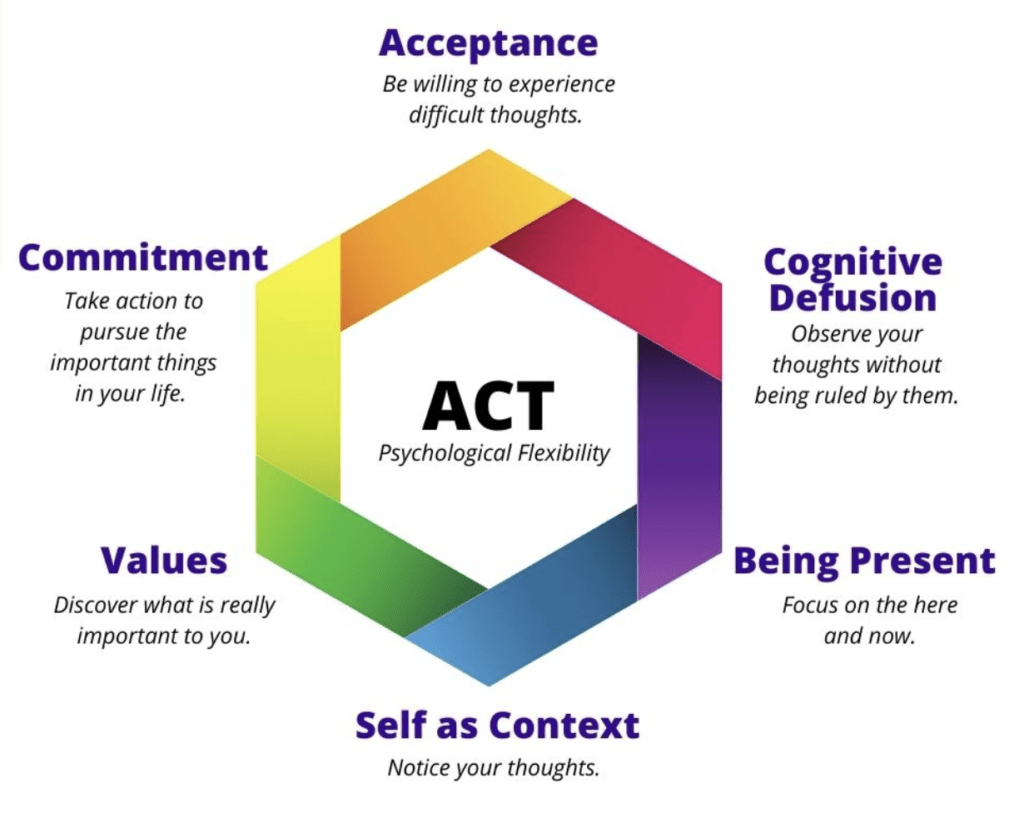
Acceptance & Commitment Therapy (ACT)
Guess what? We can feel bad, yet still act from our best-self space. I’m not encouraging you to ignore your feelings, but want to help you learn to live in alignment with your values in spite of how you feel. A value focused life leads to more life satisfaction and peace of mind, desired by every person or couple that comes my way.
Acceptance and Commitment Therapy (ACT) is a highly effective, evidence-based approach—especially helpful for anxiety disorders, burnout, and major life transitions. Since learning ACT, I’ve used it in approaching most of my problems (internally and externally) and have found it incredibly freeing. In ACT therapy, instead of spending energy trying to eliminate difficult thoughts, you’ll learn mindfulness skills and gain practical tools to increase clarity.
For individuals and couples, ACT therapy builds psychological flexibility—the ability to stay grounded in the present moment while taking meaningful action. Whether you’re struggling with intrusive thoughts or relationship stress, ACT helps you move forward with purpose instead of fear.

Polyvagal & Nervous System Therapy
If you can often identify with being totally shut down or emotionally overreactive, your nervous system may be stuck in pure survival mode. Polyvagal therapy (insert internal link: https://therisingsuncounseling.com/polyvagal-therapy-trauma-healing/) is a neuroscience-based approach that helps regulate your body’s stress response to restore a sense of safety.
Polyvagal therapy focuses on the autonomic nervous system and how it effects our body’s reaction to danger. In therapy, I’ll help you learn to find early warning signs that illicit a sense of fight or flight or frozenness. I’ll also help you learn practical nervous system regulation tools in order to activate the ventral vagal system (calm state) and learn to look for safety cues in your environment to pull you back from a dorsal (high stress) state.
Whether you’ve experienced significant trauma or not, working with your body, not against it, will result in a clearer connection to yourself and those you love. Polyvagal therapy moves beyond traditional talk therapy and help repattern the nervous system so that you can feel safe, versus talking about what safety might feel like. For those of you who can identify with these struggles, I’m sure you are able to hear how much of a game changer nervous system regulation can be.
The Gottman Method
After just 30 minutes of Gottman training, I knew that it would be an incredible resource for supporting couples. What I love about the Gottman Method is that it doesn’t sugar coat with suggestions like “just learn to compromise” or “relationships are hard, but worth it.” Gottman’s initial focus is based on managing conflict, meaning that this therapy is fundamentally based on the idea that all couples fight.
John and Julie Gottman have spent over 50 years developing a structured method that focuses on improving communication, (re)building trust, and strengthening emotional connection. While helpful to all relationships, the Gottman Method is particularly effective for couples dealing with frequent arguments, emotional distance, or recovery after betrayal.
As a result of my training in this modality, if you work with me as a couple, you’ll appreciate the lack of vague advice, but rather, than clear, actionable strategies you can apply immediately. If you are able to be honest with yourselves and one another, willing to learn the skills and strategies of Gottman work, and actively apply them outside of therapy, you will have a masterful, healthy relationship.


Somatic Therapy
If you long for more depth than traditional talk therapy offers, somatic therapy may be the key you’ve been missing. When overwhelming experiences aren’t fully processed, they often become stored in the body—showing up as tension, fatigue, or emotional reactivity.
Somatic therapy helps you reconnect with your body through guided awareness, breathwork, movement, and nervous system regulation techniques. Through training and the willingness of my clients to walk through discomfort, I’ve found many ways to help
Somatic therapy is especially effective for trauma (PTSD), anxiety, panic symptoms, and feeling disconnected or “numb.” For individuals and couples, it can improve emotional awareness, reduce reactivity, and create a stronger sense of safety and connection. Healing happens not just in your thoughts—but in your whole body.
Motivational Interviewing
Motivational Interviewing (MI) is a way of being, a person centered approach that acknowledges the profound difficulty of change. Through the use of MI we finally explore why “just do it,” just doesn’t work for many difficult human experiences.
By accepting the difficulty of change, we can then collaborate in exploring your stuckness, repeated habits, and what you get out of maladaptive strategies, like procrastinating. Motivational Interviewing can move you from utter an utter mental bind towards changing based on uncovering your own internal motivation, versus me or any of your loved ones pressuring or advice giving.
Motivational Interviewing can truly support with any part of life that is halted by inaction, but is most often indicated for people who struggle with chronic health conditions, substance use disorder, gambling, and other compulsive habits.
With couples, the spirit of MI can help resolve ambivalence around big decisions like moving, taking a next step in your relationship, or parenting barriers. In any case, Motivational Interviewing takes the insight you come to therapy with and turns it into action which, through practice, can result in life changing lasting change.


Attachment-Based Therapy
Attachment-based therapy focuses on how your early relationships shape your current patterns in relationships, often relative to distrust, and barriers in emotional connection. If you struggle with fear of abandonment, emotional distance, or conflict in relationships, your attachment style may be playing a key role.
None of this is to say your parents necessarily did a poor job, although they may have, it may simply say they didn’t help you form the secure attachment bonds you needed. Using some evidence based tests of attachment styles, together, we identify attachment patterns such as anxious attachment, avoidant attachment, or secure attachment—and understand how they show up in your daily life.
Through this work, you can develop healthier ways of connecting, communicating, and feeling safe with others. While this work requires processing, I am also quite committed to providing you with practical suggestions on how to work with your attachment style, acknowledging that your partner may be making demands of you that feel near impossible.
For example, if you are a person who struggles with avoidant attachment, perhaps because you learned that you couldn’t rely on others early in life, but your partner craves more emotional closeness, it is likely that it feels viscerally unattainable for you to engage in that way.
One idea is setting a boundary in your relationship for small doses of vulnerability on your time. We can work towards something like you being able to state to your partner: “I can talk about the argument we had this morning but I need to do it once the kids are asleep and I’m hoping we can set a ten minute time limit? I care about you and I don’t want to completely shut down.”
Attachment therapy can be incredibly effective when we incorporate both processing the ‘why’ and ‘how’ of your attachment style and introduce practical skills. Whether you’re working individually or with a partner, this approach helps create deeper emotional security, stronger bonds, and more fulfilling relationships.
Online Therapy
There’s no two ways about it, online therapy, or telehealth, is significantly easier to integrate into busy schedules while reducing barriers. Its biggest advantage is accessibility— my clients attend sessions from home, work, their cars, eliminating the need for commuting and parking at an office. Another major convenience is flexible scheduling.
I provide early morning appointments, as well as biweekly weekend appointments. As a result, individuals and couples who see me are able to receive consistent support without disrupting work, childcare, in bad weather, and while moving. The reliability provided by telehealth results in better long term outcomes because of our stronger therapeutic relationship.
Another key benefit is enhanced privacy and comfort. Attending therapy from a familiar environment can reduce anxiety, making it easier for clients to open up and engage. I’ve had several clients identify with the idea of the computer screen being an emotional shield, making it easier to blurt out difficult statements they may otherwise think are taboo.
All you need to prioritize your well-being is a secure internet connection. While my fees are not inexpensive, it’s worth noting the cut down of travel expenses, childcare, or time away from work. It’s important for our work to be hard, but not hard in the way that it is incredibly difficult to fit into your life. Consistency supports the momentum we will inevitably build.


Phone Therapy
After some time providing therapy virtually, some of my clients began to ask for phone calls. Two of the most significant reasons for therapy via call (versus video call) have been: clients are who are traveling from work to home and those who choose to walk and talk.
Even if we cannot walk and talk together (see more about the benefits below), some clients find it super beneficial to exercise and engage in vulnerable conversations at the same time.
Truthfully, some clients do laundry, cook, etc., and I am happy to accommodate, so long as you can pay attention as it is imperative that we do meaningful work. It’s important for our work to be hard, but not hard in the way that it becomes impossible to fit into your life.
Walk and talks
Come take a walk with me along the beautiful Eastern Trail, or another peaceful outdoor setting we choose together. Walk and talk therapy offers a refreshing, holistic alternative to traditional office sessions—one that supports both emotional healing and physical well-being. These sessions are typically at least one hour and may cost slightly more than virtual appointments, reflecting the extended time and unique benefits of this approach.
If you’ve been searching for walk and talk therapy near me, outdoor therapy for anxiety, or movement-based trauma therapy, you may already sense that healing doesn’t always happen best while sitting still. The mind often works differently when the body is in motion. Many clients find that as their body moves forward, their thinking becomes more flexible, creative, and open.
There is also a strong connection between movement and emotional processing. Trauma, stress, and anxiety are not only cognitive experiences—they are held in the body. Incorporating gentle, rhythmic movement like walking can support the nervous system, helping you release tension and feel more grounded. This is why walk and talk therapy can be especially beneficial for those seeking somatic therapy for trauma or unique, natural approaches to mental health counseling.
Walking together can also serve as a meaningful metaphor for life’s journey: step by step, at your own pace, with space to pause, reflect, and choose your direction. It’s a collaborative process that honors where you are while supporting where you want to go.
Because we are in a public setting, confidentiality is an important consideration. We’ll have a thoughtful conversation beforehand to ensure this format feels comfortable and appropriate for you.
If you’re curious about trying a more dynamic, engaging approach to therapy, walk and talk sessions can be a smart, supportive choice—especially if you find it hard to sit still, struggle with restlessness, or are simply drawn to being outdoors while doing meaningful inner work.


Life coaching
Unlike psychotherapy, life coaching is non-clinical and more directive in style. Together, we’ll actively identify goals, remove obstacles, and create practical strategies to help you move forward with confidence. Whether you’re navigating a coaching style for your relationship or life coaching for personal growth, coaching provides structured guidance and accountability. I practice life coaching with a lot more strategy and action plans than therapy. Life coaching does not involve much processing of the ‘why.’
As a skilled clinician, one of the primary reasons I’ve chosen to offer life coaching is due to bureaucracy. Due to lack of regulation, as a life coach I can support you even if you live in a state where I’m not licensed to provide clinical therapy (outside of ME, MA, NH, or FL), which is a field that has many laws and regulations I must adhere to.
Because life coaching is not mental health treatment, it is not eligible for insurance reimbursement. However, many clients appreciate the flexibility, accessibility, and action-oriented nature of this work. If you are looking for virtual life coaching that is more in the style of a motivational coach and guided by results, life coaching can offer an empowering path toward lasting change—no matter where you’re located.
Individual Intensives
Individual therapy intensives can serve as either a powerful alternative or a meaningful supplement to traditional weekly therapy sessions—offering an intensely focused approach for those ready to dive deeper. Intensives are ideal for individuals who want to tackle a specific issue—such as anxiety, relationship concerns, or a major life transition—without committing to ongoing weekly therapy. They can also be helpful for current clients who feel stuck on one recurring challenge and want dedicated time to work through it more effectively.
If you prefer in person therapy or extended therapy sessions, I hold these sessions in my home, just 20 minutes from Portland, ME. While I am a firm believer in the accessibility and benefits of virtual therapy, I think this work is best done in person, especially due to the length of time each of us is required to focus. Due to the vulnerable nature of inviting people into my home, I hold the right to interview people for a sense of safety in my space.
These 6-hour individual therapy intensives, first include assessment(s) that I email you prior, looking at the results together as they fit into the therapeutic modality(s) we practice. Then, we discuss how we will work through issues. With your input in mind, we choose an approach, sometimes multiple, and get to work at a fast pace. Often, we will include at least a little bit of mind/body, somatic work to center or recenter our work, as hours of therapy can be dysregulating. I promise to be thoughtful,
Each intensive includes a comprehensive assessment and a personalized, integrative approach. I draw from a range of evidence-based therapies, selecting the methods that best fit your goals and the specific problem you want to address.
Individual therapy intensives can be a powerful option for those seeking accelerated healing and a deep, focused mental health experience. However, this format is not ideal for everyone. Because sessions are longer and more concentrated than traditional weekly therapy, the process can feel emotionally demanding—especially for individuals with unresolved trauma or those who benefit from a slower, more gradual approach.
This level of deep emotional work may bring forward strong reactions, including anxiety or emotional fatigue. While support and guidance are always provided, it is important to carefully assess your personal readiness, coping resources, and overall stability before committing to an intensive format.
When aligned with your needs, individual therapy intensives can support meaningful breakthroughs, increased self-awareness, and lasting change in a shorter period of time. If you’re looking for deep dive therapy sessions in Maine, mental health intensives Maine, or a highly focused, personalized counseling experience, individual therapy intensives offer a supportive and efficient path forward.


Couples Intensives
Couples’ intensives are designed for partners who are seeking a focused, immersive approach to understanding and improving their relationship. Rather than the traditional weekly model, intensives offer the opportunity to step outside of daily routines and dedicate meaningful, uninterrupted time to your partnership. These sessions are available in 1–3 day formats, with each day consisting of approximately six hours of therapeutic work. While there is a general structure, every intensive is thoughtfully tailored to reflect your specific needs, goals, and relational dynamics.
A three-day intensive often begins with a comprehensive assessment phase. This includes exploring your relationship history, identifying patterns, and understanding the deeper “why” behind recurring concerns. The second day is typically devoted to actively working through challenges using a range of therapeutic modalities, allowing space for both guided interventions and real-time practice. The final day serves as a check-in and refinement period—revisiting key themes, strengthening tools, and addressing any remaining areas of concern.
For couples who prefer a more structured and research-based framework, I also offer intensives grounded in Gottman Method Couples Therapy. These intensives are conducted in 6-hour segments over 2–3 days and incorporate a highly intentional, data-informed process. Prior to beginning, each partner completes the Gottman Relationship Checkup—a comprehensive questionnaire that explores areas such as emotional connection, conflict patterns, intimacy, and shared responsibilities.
From there, we begin with an in-depth oral history of your relationship, followed by a collaborative review of your assessment results. Together, we create a clear and personalized plan for our time, which may include individual breakout sessions as well as joint work. Throughout the intensive, we utilize practical, Gottman-based tools designed to improve communication, deepen understanding, and rebuild connection.
Subsequent sessions focus on practicing these tools, with my support and guidance, while also making space to process longstanding challenges or unresolved resentments. While the pace is more accelerated than traditional therapy, the intention is not to rush healing, but to create momentum—helping you move through stuck patterns with clarity and support.
An optional third day, typically scheduled 1–4 weeks later, allows us to revisit areas that felt more challenging, address any “setback” moments, and continue reinforcing the skills you’ve begun to integrate. This follow-up can be a powerful way to solidify progress and maintain forward movement.
Couples’ intensives can be deeply impactful and, for many, transformative. That said, they are not the right fit for every relationship. The condensed format can feel overwhelming for some, particularly if there is a significant trauma history that has not yet been individually addressed in therapy. Additionally, the depth and pace of this work may bring up strong emotional responses, including sadness, anger, or guilt.
If this occurs, support will always be available. At the same time, it is essential that each couple thoughtfully considers whether this approach aligns with their readiness and capacity. When it is a good fit, an intensive can offer not just insight—but meaningful, lasting change.
I am so lucky to have met Veronica! She’s is very professional, trustworthy and educated in her field of work. She loves to help me grow and pushes me to succeed. Veronica has a true passion for helping others. Look no further she is the BEST!!
R.
I’m so grateful to have met Veronica - she is amazing. It’s difficult to find a counselor where you feel connected and comfortable. Veronica is so genuine, helpful, and easy to talk with — I strongly recommend seeing her!
T.
Veronica is a kind, knowledgeable, and thoughtful therapist. As fellow private practice owners, I’ve gotten to know her through our shared work. She’s dedicated to her clients and clearly cares deeply about the quality of care she provides.
K.
E.
Veronica is super easy to talk to and makes worries and concerns feel less heavy. I know she listens and cares without judgement.
D.
Veronica is deeply skilled, thoughtful, and uncompromising in the best way. She cares fiercely and holds people with both compassion and accountability.
H.
Recent Blog Posts




Make an appointment
If you’d like to meet with me, fill out all of the information on the form, so I can provide you with no pressure, specific answers about your care.
Please note, email is the easiest way to reach me.
location
The Rising Sun Counseling is based out of Portland, Maine. My varied licenses, however, allow me to practice therapy online across Maine, Massachusetts, New Hampshire and Florida. Telehealth sessions allow for a continuity of care. Online therapy allows me to meet with moms while they are nursing, busy professionals on lunch break, and students between classes. No more excuses! 🙂
Contact
207.560.5758
veronica@therisingsuncounseling.com